
Burton Primary School is located in the northern suburbs of Adelaide near a wetland called Springbank Waters Wetland Reserve.
At this school the project focussed on children’s connection to this wetland. This report on the project has been constructed from written and transcribed accounts from two teachers, Bernadette Haggerty (classroom Year 4/5 teacher) and Marj Francis (a volunteer teacher); student material; observations by researchers; and school documents.
A category 4 school, Burton Primary School has enrolments of over 470 students, many with complex learning needs. Up to 40% of students are on school card and 25% of students are from an English as an Additional Language or Dialect (EALD), making up 15 different nationalities. The primary school has an onsite preschool that caters for students from birth to five years. The school is very community minded and parents are encouraged to take an interest in their children’s learning.
Bernadette’s Year 4/5 class consisted of 28 students: 17 in Year 4, and 11 in Year 5; 17 girls and 11 boys. Marj Francis had been a close colleague of Bernadette’s in 2016. When a 2017 contract for Marj did not eventuate, having been introduced to the project the previous year, Marj decided to participate voluntarily for one day a week. Every Tuesday for a school year the teachers and students dedicated time to the water literacy project. Having an extra teacher in the class was an added bonus that enabled creative and adventurous planning. SSO Cath, who was often in the class to provide support, could see how powerful this learning was. Cath therefore volunteered so that the class could attend the wetlands weekly for a double lesson. Cath was enthusiastic about the topic; she shared her knowledge with the students and encouraged them to fossick and discover.
The close proximity of Springbank Waters Wetland Reserve to the school meant that students had ready access to it. Visits to the wetlands on Tuesdays were usually completed in a double lesson period, however sometimes a second session was included to ensure adequate time to address a particular focus area. The class decided to use three different locations around the reserve area to collect data. Groups were organised in three teams of three students, with one group at each location. These became known as the deck, bridge and waterfall groups, with names indicating the locations where testing was done. For some of the time there was a third adult in attendance, as Bernadette mentored two pre-service teachers over the year. Because the bridge and waterfall areas were close together, Bernadette was able to oversee both areas when a third person was not available.
The aim of the Fresh Water Literacies project for the Burton teachers was to connect students with real life issues surrounding fresh water and nature in their community using:
- A student-centred learning approach to drive the inquiry and develop engagement in the learning.
- Citizen science projects focusing on the local wetland environment to provide authentic contexts.
- Expert specialists from the community and UniSA to provide scope for deeper knowledge and skills acquisition.
The teachers summarised the project aim as being focused on connecting students to their local wetlands to develop:
- an appreciation and better understanding of the interconnectedness of nature to themselves, including thinking about the future.
- an understanding of their role in managing local environments as citizens.
- an understanding of how science is related to our lives and can help us to respond to issues surrounding the management of fresh water through citizen scientist projects.
In addition to the visiting artist, a key resource throughout this project was National Resources Management (NRM) Education. Project officers visited the class regularly and the students were involved in the identification of macro invertebrates, water quality testing, bird monitoring, rubbish collection, the Feather Map project1 and the Bowerbird project.
1 Feather Map is a citizen science project about collecting wetland bird feathers found on the ground or in the water to help researchers create the first ever Feather Map of Australia. It is managed jointly by ANSTO, Centre for Ecosystem Science and University of New South Wales, Australia https://feathermap.ansto.gov.au
Bernadette and Marj used a variety of ways to collect data for evaluation purposes and this included prior knowledge questions, student engagement activities that connected to the topic fresh water, student directed learning examples, community experts, student work stations at the culminating evening expo, and presentation of brochures to the community and customers at a local shopping centre.
The teaching approach used by Bernadette and Marj was planned collaboratively and can be described as transdisciplinary. In relation to the wetlands topic, teachers were explicit within a range of disciplines: literacy, science, mathematics, humanities and social sciences (HaSS). It was an effective model but one that was well resourced with an extra teacher who was passionate about science and volunteered a day a week throughout the year.
An effective approach to recording students’ ideas and thoughts around the learning was the use of a reflective writing process. During Term 1 and Term 2, students completed regular reflections in their STEAM workbooks, and sometimes their science journals. In Term 3 the learning journal was introduced to provide a place for these reflections to be more easily accessed by students and the teachers. A format/ guide was also provided to scaffold students’ writing/ reflections. This was part of the focus by Bernadette to develop skills in reflecting on the learning journey. It helped demonstrate what was understood about tasks and goal setting and helped students recognise that mistakes help us question/ learn more about topics across the curriculum including topics outside of the project. The shift to recognising themselves as drivers of their own learning, developing positive attitudes to making mistakes as part of the learning journey, and developing an ability to recognise learning goals helped students to become independent learners. Students’ reflections about the project work were sometimes written in a recount format, and often included their challenges in efforts to work collaboratively, and this developed as a safe communication area. This approach also allowed Bernadette to respond and provide feedback to questions or concerns in writing or to ask to talk with students if required.
Bernadette created a letter as a stimulus for a persuasive writing task based on the experiences of the wetlands and futures thinking about the wetlands. The letter was written as if it were from the local council, and written in full view of the students (it was displayed on the whiteboard as she worked on it) who were completing a different task. After the class had completed their work she read the letter out to them, stopping to ‘fix’ spelling mistakes as she went along. The letter was written in child-friendly terms and used a persuasive writing approach to suggest reasons why the wetlands needed to be filled in and housing built in its place. Reasons included many things that the students had been learning about or researching in the project such as:
- Low levels of macroinvertebrates because of pollution levels (a concern that many students expressed before they realised that macroinvertebrates breed seasonally) causing a shortage of macroinvertebrates that was hard to replace by the council.
- People slipping on duck poo because ducks were continuing to be fed bread which upset their stomachs and caused them to produce excessive waste.
- High levels of rubbish continuing to be washed into the wetlands stormwater catchment nets showing that people in the community were not caring properly for the wetlands and this was costly for the council to manage.
Once Bernadette had finished reading out the letter students sat mute, completely shocked for a prolonged period, ignoring the dismissal bell and quietly processing the ‘bad news’. Finally, one student exclaimed: ‘We should protest!’ All the other students agreed and exclaimed that they too would protest. It took some time to calm the students and reassure them that the letter was not real and filling in the wetlands would not happen. The students insisted that they should write letters anyway to explain why the wetlands were so important and should be kept. This demonstrated how invested in and protective of the wetlands the students had become. They had become proficient in their understanding of the processes of local and state government and their own role and responsibilities to their community. They had developed confidence as citizen scientists to respond to the threat of their beloved wetlands with a wide range of knowledge about the biodiversity of the wetlands and the issues of stormwater pollution, and through their own research about birds and the weekly monitoring of the water quality, macroinvertebrates and birds that were using the wetlands. They had been collecting and disposing of rubbish in their monitoring of the litter around the wetlands, and developed understandings and viewpoints about how to lower the impact of pollution in the wetlands. The response letters written by students showed that they had become great communicators, well able to use their knowledge to protect their ‘place’, and they were able to articulate how its loss would affect them as they struggled to imagine their community without a wetlands.
Burton teachers provided scope for students to explore their own questions relating to water through:
- Experiments that students chose to explore ideas about water.
- Observation walks to the wetlands.
- Providing access to internet and books.
- Lessons to explore ideas and develop scientific method and skills to equip the students with research and observation skills.
- Posing the project questions.
- Establishing the wetland context geographically/ historically.
- Citizen science projects.
- Introducing mind-mapping as a shared reflection and planning tool.
- Posing and sharing challenges from teachers, between schools and from students.
- Further question and reflection activities.
- Mini lessons /explicit teaching of skills related to the projects as required.
Students became quite quick at the NRM water quality testing processes, bird count and rubbish count/collection. They also collected feathers for the Feather Map Project and each group had an iPad to take photos that might be uploaded onto the Bowerbird site. Students were provided with an art book. This was used as their science journal in which they recorded data. They were also encouraged to make annotated/ labelled observational drawings of interesting sightings, or things which they wanted to know more about or which made them question what they knew. Some students made videos to document their observations and questions.
Thursday visits occurred once a fortnight in the form of a well-being walk. These visits came about due to student reflections about the wetlands and, in particular, their interest in seeing the other side of the wetlands at the reserve. Many students asked for a chance to explore the wetlands walkway that circled the wetland at the reserve. Students were able to explore and compare areas of the wetlands environment and animals and create maps, and many researched questions of their own without prompting. This highlighted to teachers and students how much confidence as researchers and citizen scientists the students had gained. Students presented their findings and information to the class randomly as time allowed.
To conclude the water literacy topic the class had an expo. Groups of students set up stations in the hall and over 80 parents and grandparents attended to engage with the learning. It started with a sausage sizzle (this was free as the money was raised by selling duck food) and finished with an evening walk around the wetlands.
Art
Artist John Whitney provided a day-long workshop at the beginning of Term 2 to teach observational/ scientific drawing techniques. He introduced warm-up activities and sketching with pencils, sharpies, graphite and bamboo reed ink pens. Students were encouraged to draw what they observed, not what the brain thought it looked like (see image below). Other skills focused on were shading, pattern-making and learning to detail small areas of larger objects, including preserved wetland birds from the Nature Education Centre. This workshop was extremely useful and beneficial to the students. Drawing and sketching became more purposeful and improved over the year. Students each had an art book called the science journal in which they recorded weekly drawings and data collected for the citizen science projects.
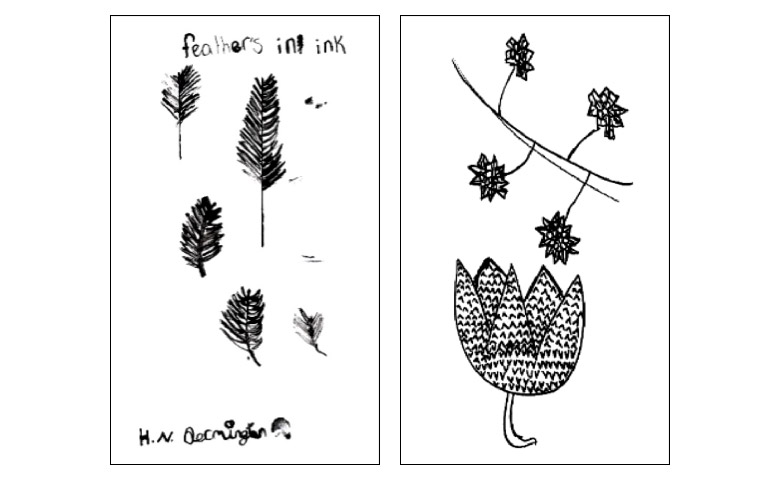
John set two challenges:
- a bird puzzle challenge to shade in and put together a pelican and a magpie.
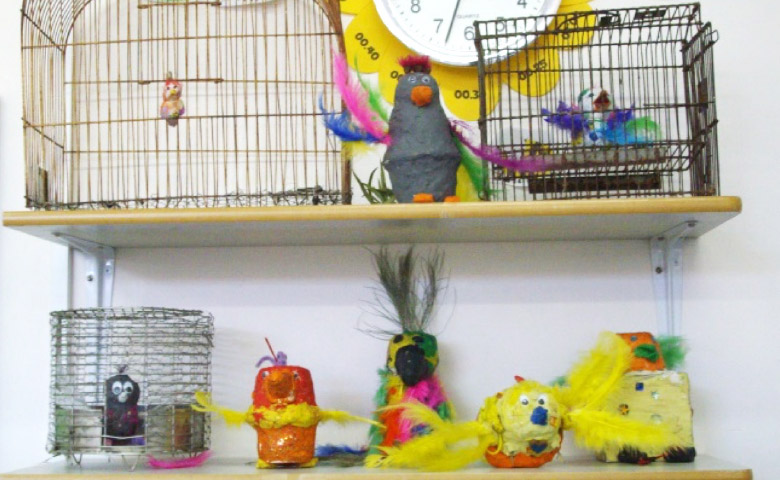
- an exotic bird challenge to create a bird, its call and how its features helped it survive in its habitat; its habitat, breeding and feeding, and prey and/or predators (see image below).
Students created 3D models of their birds and presented these to each other and at the expo. They challenged each other to find interesting world birds and extinct birds and presented these as posters to each other and later at the expo.
Students were challenged to create line art using photographs of their own wetlands and cut these photos to create interesting effects. Bernadette taught students how to use watercolours to paint wetland landscapes and pelicans.
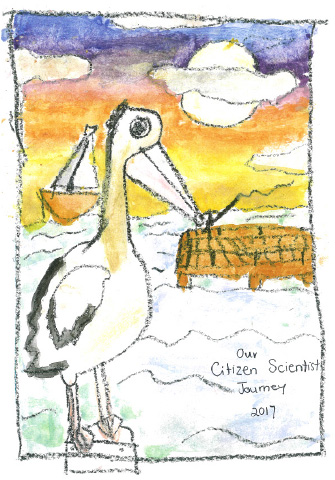
Students used these watercolour painting skills to illustrate their citizen scientist journey book at the end of the year (book cover right shows the painting selected as the cover of the book).
Our Citizen Scientist Journal 2017
Literacy
The content of the literacy curriculum included both receptive and expressive literacy skills. While reading and writing texts were important skills developed over the year, equally important was the development of other means to communicate learning through receptive and expressive contexts.
Receptive literacy skills were developed in collaborative groups and class discussions. These focused on active listening skills in relation to body language and spoken language, critical thinking, and respectful and productive interactions. Examples of researching and reading skills developed were comparing, questioning observations, sourcing and understanding information, note-taking, reading fluency, and developing thoughtful questions.
Students developed important skills required for learning from both the wetlands and each other in collaborative learning/ working contexts. This occurred through ‘reading and responding to’ the wetlands environment and participating actively in group discussions; listening, note- taking, and responding with respect to others’ viewpoints and information. The ability to work collaboratively was enhanced by the many opportunities to talk about ideas, interests, questions and outcomes/goals. Developing research skills was important to many students as they realised how confident they became as learners. Many described how proud they were of their reading and research skills.
Expressive literacy skills were developed through the production of recounts, information texts, explanations, narratives, poetry and persuasive arguments. Also important were the processes of interviewing, using digital and computer software/hardware to represent information and ideas in PowerPoints, posters, brochures and the creation of books/ user manuals/ information books, 3D models, photography, and videos. Importantly students became very skilled at responding appropriately to each other during discussions, when moving into groups and working together. They learned to respect and use each other’s skills to become effective and collaborative learners and this created a supportive, productive, safe and happy learning environment.
Numeracy/mathematics
Numeracy and mathematics content included data collection, graphing and analysing data. Students participated in Feather Map work which involved data collection. They also undertook scaled measurements, and developed skills in estimating and measuring with informal units, financial mathematics, and fractions.
Skill development was based around problem solving and recording accurately. This included learning how to read scaled measuring instruments (e.g. thermometer), developing an understanding of accurately communicating information when graphing and analysing data using the NRM scales, and seeking explanations and solutions for data findings. When graphing and analysing data a gap in understanding was highlighted when using decimals in recording salinity data. This resulted in some explicit teaching about decimals as fractions of a whole unit, and how to record the data that was collected. This made a significant change to the data findings, and taught the students the importance of questioning and checking the data.
Reading and using maps to find information and looking at google maps created a better understanding of the scale and location of spaces being used in relation to other areas in the community and wider world.
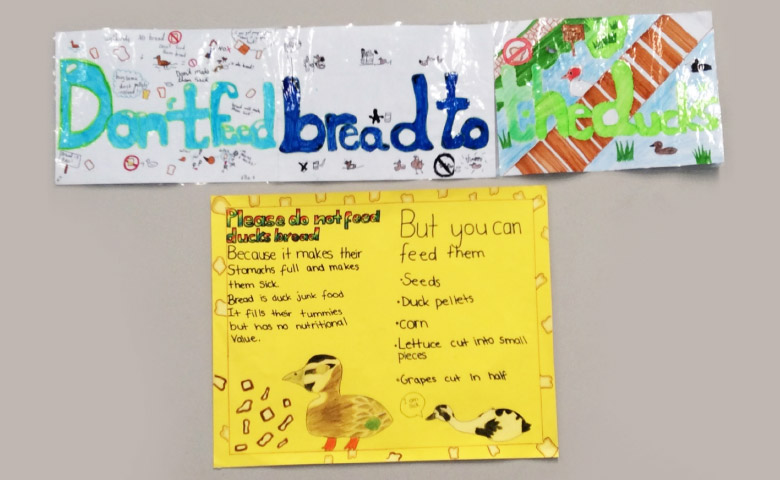
An opportunity to link financial maths with the project came about when research about the wetlands birds revealed that ducks were in danger of developing an illness called Angel Wings, caused by being fed bread by well-meaning people. This led to concern and a keen interest in communicating this knowledge to the community. Students decided to create duck pellet bags. They worked out the cost of the bags and measured and weighed duck pellets to sell for the expo at which they also explained the importance of not feeding ducks bread.
Students also created a brochure that was distributed at a shopping centre presentation. Students had to consider the design and layout of their brochures, including how it was to be folded (in thirds), and how information could be represented visually and effectively. One brochure included a map of the area.
Citizen Science
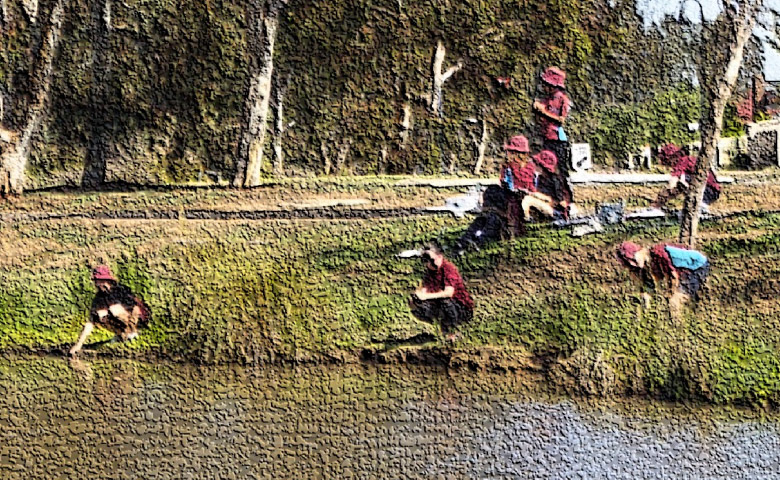
The content of this curriculum area included NRM data collection, water quality testing, bird monitoring, rubbish collection, and participating in the Feather Map (see image below) and Bowerbird projects described earlier.
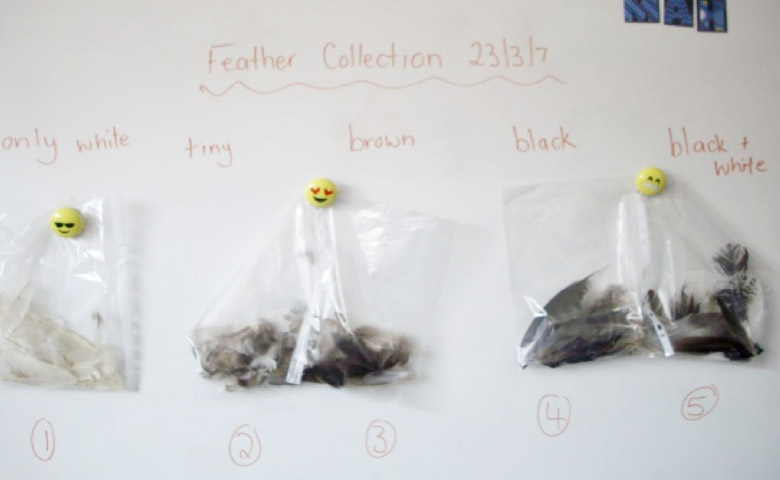
The decision to use citizen science was made in order to provide authentic contexts for students’ learning about the wetlands (see image below). Bernadette and Marj presented several opportunities for involvement in citizen science projects and used those that students voted for, due to their interest in the projects themselves. These opportunities provided purposeful engagement for the students who were proud of being able to contribute to real scientific work being done across Australia. They came to view themselves as ‘real’ scientists through their involvement in the projects and this kept the interest high and maintained commitment to the project. In particular, participation in real data collection and connection to scientists were seen as integral and engaging components of the project. The connection with scientists included a meeting between scientists and teachers (to introduce the concept of citizen science) and scientists visiting one classroom at Burton to work with students. Challenges included difficulties with uploading information onto the Bowerbird and NRM sites.
Resource based learning
Students participated in resource based learning (RBL) when they researched one wetland bird and created a PowerPoint about it to present to the class. After these were shared, one student pointed out that: ‘Now we know something about every bird that makes a home in the wetlands’.
Resource based learning was part of the literacy focus of the school and an RBL teacher worked with classrooms for two terms each year to support development of these skills. Bernadette requested that in RBL time students be allowed to research about the wetland birds they had become so interested in during Term 2. In Term 3 they were involved in a different RBL focus that was not related to the fresh water project. Nonetheless, students had become very interested in/ proud of their skills in researching for a purpose related to the project. This led to individual students researching according to their own interests about the wetlands and its biodiversity and setting challenges for each other such as world birds and extinct birds to research during school holidays. Their findings were presented to each other in class and at the expo.
History and social sciences (HaSS)
Curriculum content in this area included geography and history. Bernadette shared her knowledge of the Burton area based on her personal history of having lived in that area. Marj used google earth and maps to help students to develop their ideas about the scale and place of the wetlands reserve in the community and she tied this to the world through an investigation into fresh water across the world. At the beginning of Term 2 NRM project officer Julian Marchant came out to talk with students about this topic. He noted that only 3% of all the world’s water is drinkable and introduced the importance of caring for fresh water resources.
He explained the links with storm water and showed students how to use water quality testing equipment.
Philip Roetman from UniSA also visited at the start of Term 2 and provided information about the geography and history of land development in Adelaide and, in particular, the Burton area. He talked to students about the development of the Northern Connector Expressway that is being built currently and discussed its potential impact on birds in the Barker Inlet area. Discussion was started about a possible investigation into this topic and how the Springbank Wetlands might be affected. Philip also introduced the Bowerbird project and students were shown how to improve their photography to make sure their photographs would allow for good identification of species.
Students visited the Adelaide Zoo, focusing on the Australian aviary and other birds such as pelicans. This provided a close-up view of many wetlands birds. The Botanic Gardens wetland provided important background information about man-made wetlands, and how wetlands work to clean/store the storm water collected there. This provided an important comparison model for the Springbank wetlands with many students questioning the design of their wetlands and considering how it might be improved. It would have been good to have had more time to investigate this further.
Futures studies
Burton teachers used two strategies to elicit student images of possible futures for their wetland: production of an illustrated narrative/ story of the wetland in 30 years’ time and a persuasive text stimulus futures scenario created by the teacher.
Bernadette, a resident of the area twenty years previously, indicated that she could not herself imagine that a wetland was possible, yet one was now established. She encouraged the students to imagine how the wetland could look in 30 years and to write and draw what they envisaged. She reflected:
We brainstormed what the wetlands could look like in 30 years. This included things like flying cars, robot rubbish collectors, Pokémon hideouts and automated ‘just about everything.’ This is more of a reflection of the cartoons they watch on Netflix.
Students could write as themselves, a fictitious person, or as an animal that lived at the wetlands. Stories ranged in their contexts with some students projecting themselves to be educators, scientists or aged versions of themselves, and some used animals to tell their stories, such as a duck that took people on a tour of the new improved wetlands and could talk because technology made it possible to fit a translator to animals so they could be understood by humans.
Students were asked to reflect on their learning near the end of Term 3 and to note any concerns and hopes they held for the future of the wetlands. Most students reflected that staying involved with the area would be the most helpful, including visiting frequently, bringing their families and trying to improve the wetlands with more trees and plants to encourage more bird and animal life. Many were fearful that the wetlands lands would be used for other purposes like farming, housing or businesses.
Marj had conversations with students who wanted to build a bridge across the wetlands so they could see ‘everything’ and many said they would love to build treehouse bird watching platforms so they could see more. This was a common theme in many of the students’ drawings. Some students decided that the wetlands would need to be protected and made into a zoo so people could visit and it could also be preserved.
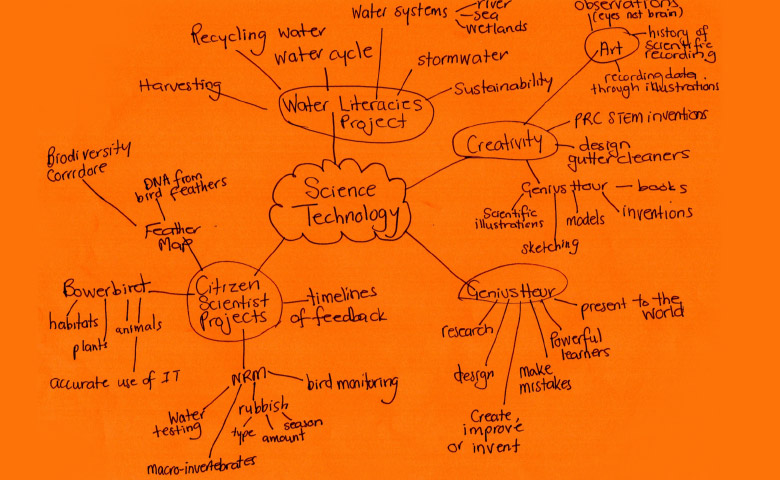
Mind maps (see image below) became a tool used by the students as well as teachers to quickly communicate ideas and reflect on their learning.
Science
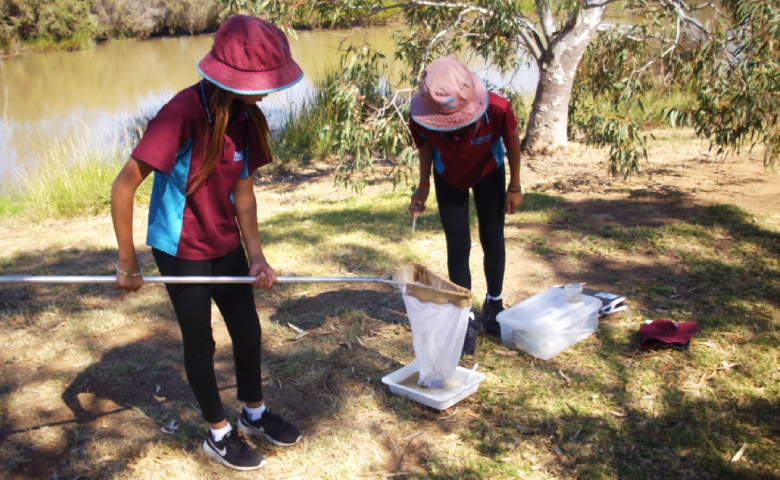
Science content was central to this project based on the study of fresh water wetlands. Students were involved in the scientific testing of water (see image below); the identification of birds based on features and adaptations; and a study of macroinvertebrates – their features and adaptation, and how they function as bio-indicators of pollution.

Water concepts developed included those about evaporation cycle, salinity, movement of water across land, technology and supply for water, scientific testing and investigations (see image below). Activities to develop these ideas included student driven investigations on evaporation cycle, salinity, water movement, audits and observation walks around the school and wetlands to look at gutters, storm water drains and potential pollution issues.
Activities included introduction of observational drawing, bird counts, using ID charts, books, the internet, and Nature Education Centre preserved birds. The focus was on bird features and how these helped them to live and survive in their habitat. Students identified birds that seemed to prefer/inhabit certain areas of the wetlands and this led to further student-driven questions and investigations.
Design technology
Design technology activities included photography on iPads, uploading photos on to Bowerbird, producing PowerPoints, impromptu videoing, and using web search engines to research information. Time was a large factor in being able to develop these skills.
Students became highly competent at using digital technology to support and communicate their learning in PowerPoints. Bowerbird was difficult to use and access as effectively as we had hoped due to issues re uploading from school computers and difficulty in keeping student work on iPads shared by other classes. It was also difficult to access the NRM site to upload reports, largely due to a time factor in organising data. A suggestion for the future is to provide time for students to use data in computer generated programs to communicate their findings.
Students also used a range of skills to create models depicting their ideas about birds and other questions arising from Genius Hour projects2, class challenges and the STEM Premiers Reading Challenge activities3.
As a summative task the students created five brochures to hand out to shoppers at the local shopping centre about areas that they felt highlighted the wetland’s importance and its issues.
There were three guides to the wetlands and two guides to address issues found at the wetlands:
- a visitor’s guide to the wetlands.
- a field guide to macroinvertebrates at the wetlands.
- a field guide to birds found at the wetlands.
- a guide to cleaning gutters and keeping storm water drains clear.
- Don’t feed the ducks bread: a brochure to highlight the issues facing birds fed too much bread (see image below).
2 Genius Hour http://www.geniushour.com
3 Premiers Reading Challenge https://www.education.sa.gov.au/teaching/projects-and-programs/premiers-reading-challenge
Students’ reflections on the project included their wonder about the wetlands, their questions, and importantly, their pride in being able to ‘do science’, work like ‘real scientists’, and be citizen scientists. They recognised that not only were they becoming experts in the wetlands, but the entire year had been a learning journey, with one boy writing in his reflection on the shopping centre presentation that ‘I told [shoppers] in one minute what took me a whole year to learn’.
During Term 1 in 2018 when interviewed by the NRM filming team, a student explained how the project had made him a better learner. He said:
The difference in doing work for the project was that usually when a teacher just gives you work to do, you do it to get it done, and you can do really good work, but working on the project was better because you are doing work that you really want to do, because it’s interesting, and you get to really do the work you’re talking about. So the work you do is your best work because you’re proud of the work you’re doing.
Teacher Marj commented that:
I think that this shows how much students respected this project and the student driven approach. It helped them to cross the line where they recognised that their own ideas for learning were valuable.
In summary, the teachers noted that when taking a student-led approach to learning with a transdisciplinary focus the teacher becomes a facilitator of the learning, as well as a co-learner. This can be viewed as being a lot more work for the teacher, and it demands a lot of honesty in recognising that you will sometimes be learning alongside your students. As Marj explained, the learning journal was introduced to help teachers manage the situation.
This was due to me being bombarded every morning with their ideas and learning requests. I asked them to write their ideas down. I would read them and then introduce the topic with: 'Panayioti wrote in his journal that he wants to write a play…' And the new learning was born.
That is, the learning journal not only allowed students to reflect on their learning, but also to share their ideas and problems with the teacher and their peers.
Teachers noted the importance of being clear about the learning aims, outcomes and learning processes for each area and being ready to use students’ ideas for learning as springboards towards the Australian Curriculum learning goals and achievements that can be developed from those learning experiences. Teachers also have to be aware of the alternative (mis)conceptions that students can hold about a topic and be ready to conduct mini-lessons, or to follow up with explicit teaching about aspects of the learning as the need arises.
An example of this was in the data collection and graphing when it became apparent that students were not recognising the decimal point. This affected the ways in which salinity was being recorded and graphed/ and caused confusion with the analysis of the data. Explicit teaching about the correct way to read the salinity meter and accurate recording and graphing techniques was required. This helped students to understand the importance of accuracy in data and that data told a story about what was happening in the wetlands.
In summary, Bernadette and Marj noted the successful aspects of their approach:
- Group work skills/ relationship building/ valuing each other’s knowledge.
- Continual questioning.
- Private research and sharing it/ challenging each other.
- Learning to participate in discussions.
- Reflection journal.
- Student research skills/ RBL/ Genius Hour.
- Expo and presentations/ displays.
Many aspects of the wetlands study topic connected to Burton Primary School’s learning priorities of literacy, numeracy and science and technology and a focus on developing powerful learners through implementing quality teaching and learning practices. Marj and Bernadette agreed that the strength and impact of the classroom research around water literacies involved:
- Sharing and borrowing ideas among colleagues and experts.
- Challenging your own teacher practice and methods.
- Building knowledge and confidence.
- Building a network of experts.
- Covering the curriculum and more!
- Improved grades.
- Feelings of satisfaction.
Finally, Burton Primary School teachers made commitments to continue successful elements of the project. For example, as a result of an audit of the school with Dan French of French Enviro, the school made a commitment to become more eco friendly. The school is looking at ways in which to harvest water and save through solar or other green means to power the school. Bernadette’s class was involved in auditing the water use for the school but also conducted an audit of the storm water drains, grey water and sewer drains in response to students’ interest and concern about water and where it ends up, in particular the stormwater pollution in the wetlands. The audit provided scope to teach about data and graphing and for students to become analysts of data for action and purpose.
In another development, the school was offered a plant voucher to create natural gardens. Bernadette’s class had input into the type of butterfly garden that could be created and this was completed by the end of the year. Burton also volunteered to host the next Natural Resource Management Education student voice summit and has continued to make presentations about their ongoing sustainability work to staff, parents and the wider community.
A culmination of students’ reflections occurred at the end of the year in a student-driven task to create a ‘storybook’ of all the experiences that the students considered to be most important highlights of the year as citizen scientists. They brainstormed and chose the most important aspects of the learning that had occurred and each student wrote a reflection and illustrated their own topic with a watercolour painting. This book was created in the last three weeks of school and students were editing drafts and painting their illustrations right up until the day before school finished. The book was printed, collated and stapled so that each student could take this as a memento and celebration of the learning journey over the year. A copy was given to the school library and the book was also shared with members of the UniSA project team.
Perhaps the most significant outcome for teachers from the Burton water literacy project was the connection of children in their class to their place: the wetlands. The students never tired of their weekly walks to the wetlands and a real sense of ownership was developed. This was demonstrated when Bernadette used a scenario-building technique that suggested that the council had decided to fill in the wetlands and build housing and also in other futures work that was done.
The following dot points summarise the perceived outcomes from using a transdisciplinary learning approach with Fresh Water Literacies as the theme:
- Improved reading through research.
- Improved writing through real issues.
- Connection to local and state government processes.
- Improved maths through data collection and recording/measurement and number skills.
- Improved science skills through building knowledge about wetlands environment.
- Improved arts skills through photography/ media and digital technology/observational drawing – drawing scientifically.
- Wellbeing – becoming connected/ sharing with community.
- Alison Lynch, principal, Burton Primary School
- Nic Dale, deputy principal, Burton Primary School
- Cath Summers, SSO, Burton Primary School
- Julian Marchant, NRM Education and City of Salisbury
- John Whitney, Adelaide artist and educator
- Dan French, Sustainable Schools consultant and educator; French Enviro
- Philip Roetman, UniSA
- Jarrad Kilsby, teacher, Barmera Primary School
- Joanna Whitehead, teacher, Barmera Primary School
- Lorretta McMillan, teacher, Goolwa Primary School
