
Goolwa Primary School is located near significant bodies of water: the Murray River, Hindmarsh Island and Currency Creek. During the Fresh Water Literacy project, a Year 4/5 teacher explored students’ understandings of the problems associated with being located at the mouth of the river and the proliferation of carp.
The Goolwa project draws on written and transcribed accounts of one teacher, some student work, and observations of the class at work made by project researchers. We foreground the teacher’s intentions, her ‘plan’, and the initial stages of ‘student work’. We conclude with a section that draws on responses of the researchers and discusses specific inhibitors to the realisation of this project.
Goolwa Primary School is described on its website as follows:
Goolwa Primary School serves students from the local community and surrounding areas including Hindmarsh Island and Currency Creek. The school caters for students from Reception to Year 7 by delivering a broad and diversified curriculum with a focus on Literacy, Numeracy and Digital Technologies. Goolwa Primary is a community school, which exists to provide the best possible learning environment for our students.
The school is highly regarded for the programs that support the development of the whole child with particular emphasis on Critical and Creative Thinking; Ethical Understandings; Inclusivity; and Social Responsibility. Students are involved in ongoing programs that focus on environmental education and sustainability including regular work with NRM Officers and River Murray Landcare programs.
Of particular note with regard to the Fresh Water Literacies project is the location of the school – near significant bodies of water: the Murray River, Hindmarsh Island and Currency Creek; its focus on transdisciplinary education; and its focus on environmental education, with a specific focus on water programs.
Goolwa Primary School is a category 3 school with a 2017 enrolment of 293 students (1 NESB and 18 Aboriginal students). In their 2017 context statement, the school identifies as being made up of ‘predominantly Anglo-Saxon background’. At the time of the project, 26 students had a Negotiated Education Plan1 and 49% of families were School Card holders.
1 The purpose of the NEP (Negotiated Education Plan) is to support access, participation and achievement in the mandated curriculum for students with disabilities.
Year 4/5 teacher Loretta McMillan volunteered to be part of the research. She was on a one- year contract in the school but had previously been involved in related environmental projects as a teacher interstate. She summarised her project as follows:
The aim of this project is to develop and implement a robust interdisciplinary curriculum in science, history, mathematics/numeracy, English/literacy and the arts, focusing on ‘fresh water literacies’. Topics include global and urban water cycles and their place in ecological systems, public health and fresh water quality, invisible water use and water's cultural significance.
Given the school’s location near bodies of fresh water, there were many possibilities for conducting locally relevant research. The students had read an article about the problem of the proliferation of carp in the Murray River to the detriment of indigenous fauna and flora. Loretta wanted to be guided by students’ interests and questions and she was also very concerned to make accurate scientific information accessible. In addition, her goal was to ensure that a balance of views about carp was available. In order to fulfil these ambitious goals, she was very receptive to the idea of inviting local community members and scientists to present to her class. However, she was faced with many challenges when trying to organise this:
I rang a lot of people and, ‘oh no, that’s not my department I’ll put… you on to someone else…’ and so I found it really hard to go any further because I would have really liked someone to come and actually speak to the kids rather than me and yeah – I just – I didn’t get anywhere.
Loretta summarised her experience of trying to find the appropriate scientific expertise ‘as just dead ends’. From Loretta, we learned of the challenges of designing a responsive curriculum which attended to students’ emerging questions and local debates in ways that the teacher could be assured that she was doing justice to ‘the science’. The amount of time she spent searching for people who could help and who were prepared to speak to children was considerable. Other ‘road blocks’ included snails eating their plants and lack of support to assist the class to visit the river or go fishing.
Her students were extremely interested in a proposed solution they had read about in the newspaper which was to deal with the over-abundance of carp by infecting the carp with a herpes virus. This raised a range of ethical and pragmatic concerns. On the one hand, students were unsure about ‘the fairness’ of making these fish sick. On the other hand, there were also unknowns associated with this solution. For instance, what if the virus spread across species? What if the virus killed so many fish that the dead and dying fish began to further pollute the river? Loretta typed up the students’ inquiry questions, listed below:
- Will they be toxic to humans, other fish and plants? How bad are carp for the river (they knew they were bad but they didn't know what impact they had)?
- They want to know about the size and has the virus been tested and will the virus kill the eggs?
- Why do they want to kill them? Would the virus infect humans?
- Will the virus make you sick if we swim in the river? What will the virus do to the carp? Will it kill the carp?
- Will the virus affect us and other animals? Do the carp have any beneficial uses?
- Impact on the bird life?
- Is there another way to get rid of carp?
- How does the government and scientists know the solution will not fail or further disrupt?
- What biological differences do carp have to native fish that causes the virus to affect only carp?
- How will thousands of fish carcasses disrupt the ecosystem?
- Where and how are they putting the virus in the water? How long will the virus take to kill the carp?
- Has the virus been used before?
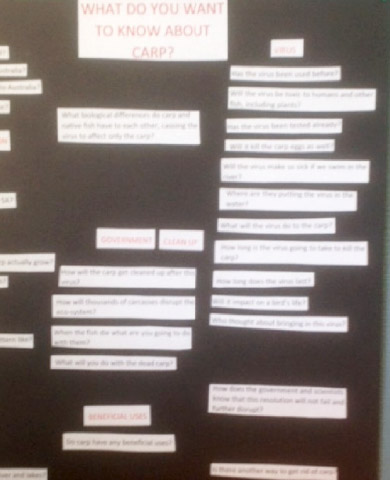
These questions indicate an awareness of complex ecological relationships, ethical concerns for the non-human world, and an openness to innovative problem-solving.
Loretta invited students to look at their list of questions and asked, ‘what questions are the same’? They then put the questions into categories, and presented them in poster form for display in the classroom (see image right). They categorised the questions into virus, reproduction, habitat, and beneficial uses. The plan was then for students to focus on gathering information in one area in depth and to use that information to design and produce posters. As Loretta explained it:
some will be doing virus, and some doing beneficial uses, some doing other ways of controlling [the fish] like fishing competitions, and one boy wanted to do something about cleaning up after the virus.
Loretta’s aim was to reduce the range of topics and questions the students would need to investigate in order for them to achieve a depth of understanding. Their investigations would involve considerable on-line searching and reading of a range of materials, not necessarily designed for young people.
From the outset Loretta was aware that not all current and relevant information would be easy to find and she did considerable out-of-hours research in order to seek expertise. These are big questions by any standard, and questions that are crucial to designing a curriculum for the Anthropocene. However, they are not easy to answer, nor is it even easy to access reliable information that is accessible to primary aged students. This makes such questions even more important to explore.
Loretta made a number of plans in designing her integrated curriculum to examine this problem.
We are doing the poster work and from there it's getting someone who can actually come in and talk to us about the virus. I did e-mail someone and rang around, [It didn’t]… quite fit… different groups and organisations and they put me onto one guy who I emailed. I wanted someone other than me to talk to the kids but I haven't heard back so… I want someone to act to talk about the virus because of the questions that were asked. I had the woman come in about the carp and the food [but] the kids just wanted to bombard her with questions about the virus.
In the meantime, Loretta wanted to consider the semiotic aspects of environmental communication and the embodied experience of being in a place and relating to the non-human world.
So from here I want to actually go down to the river see what signs are there… the signage. I want them to actually catch a carp, to physically look at the carp, and then have somebody that has that knowledge of fishing… the right way to kill the fish and all that sort of stuff. That's the next thing. So talking to the boy that is doing the fishing competition, seeing images of the fish, and knowing that it looks like a lot of fish [have been caught] but it hasn't made an impact with all those fishing competitions. Does not make an impact because of all the eggs that they lay. One of the girls found it very confronting because killing all these fish, and why are they going to kill all these fish, it's not their fault. So there's that perspective as well. I think the first thing is that it has come from the children, so I think that was important. I didn't want to do anything that they haven't got an interest in or wasn't meaningful to them. This was something that they actually came up with so is relevant to them and their lifestyle around the river.
Loretta’s vision for the curriculum design was rich in its range of activities, emotions, knowledges and skills. She designed an integrated approach to deep, situated and academic research into the problem the students had identified. Her intended program was very much Deweyian:
We live in a world where all sides are bound together. All studies grow out of relations in the one great common world. When the child lives in varied but concrete and active relationship to this common world, his studies are naturally unified. (Dewey, 1902, p.88)
Loretta’s approach was to allow children to examine the problem and research their questions by visiting the river, catching the carp, and talking to different people who had different knowledges of carp. It was also informed by recent approaches to language and literacy education in its explicit focus on language forms in use in situ, such as signage, newspaper articles, and material objects.
Guided by the student-generated questions, Loretta and her students undertook the following activities. The table below explains how these were connected to the curriculum.
- Carp article analysis and inquiry questions.
- School visit by the ‘carp lady’: Loretta invited a local person, known colloquially as the ‘carp lady’, to present ways of positively and productively making use of the carp when they were caught. These possibilities included: as a food, as a fertiliser and as carp leather, a material that could be produced2.
- Garden beds and planting: students constructed garden beds and planted native flora. As an experiment, some garden beds had the liquid fertiliser Charlie Carp added to them and there was a significant improvement of growth of plants even with reduced sunlight.
- Carp posters: students worked in pairs and independently to complete posters on a variety of topics: why are carp a pest?; what problems do they cause?; negative impacts of other introduced viruses and control methods for pests in Australia, e.g. rabbits and cane toads; introduction of the carp herpes virus; Charlie Carp fertilizer.
- Artwork: students worked with artist John Whitney to draw pelicans, as well as sketches of natural objects and rubbings.
Student work and connection to the curriculum at Goolwa Primary School
| Curriculum Area | Content | Comment |
|---|---|---|
| Environmental Education | Carp article analysis and inquiry questions
School visit by the ‘carp lady’ Garden beds and planting Carp posters Artwork |
All of the student work listed above engaged in environmental education. In some cases there was a specific focus on carp, and its effect on the Murray River and related areas. In others, such as the artwork, the environmental education was more broadly related to the visual production of the students’ natural environment. |
| Art | Artwork
Carp posters |
John Whitney’s workshop provided students with the opportunity to visually represent their natural environment, which in some cases was then used in the carp posters |
| Literacy | Carp posters | Multimodal text/poster production. Texts were hybrid genres, with the social purpose to inform (the community about carp), and to persuade (the community to act in a particular way regarding carp) (see images below). |
| Numeracy/ mathematics |
Garden beds and planting
Carp posters |
Numeracy skills were embedded in the activities of planting (e.g. quantities of Charlie Carp fertilizer), and carp posters, e.g. statistics related to the carp virus. |
| Science | Carp article analysis and inquiry questions
School visit by the ‘carp lady’ Garden beds and planting Carp posters Artwork |
All of the student work listed above scientific inquiry skills. |
| History | Carp article analysis and inquiry questions
School visit by the ‘carp lady’ |
The carp article analysis and the school visit by the carp lady both included elements of history, in particular, the history of carp in Australian waterways, e.g. the reason for its introduction. |
| Geography | NA | NA |
| Engineering | Garden beds and planting | The construction of the garden beds and the planting involved some basic elements of engineering, e.g. identifying appropriate areas to plant and constructing garden beds accordingly. |
| Futures studies | Carp posters | Through their carp posters, many students started to articulate future scenarios related to carp, e.g. what will happen if the carp virus spreads further; what will happen if the carp are culled? |
| Civics | Carp article analysis and inquiry questions
Garden beds and planting Carp posters |
The civics element of this unit was embedded into many of the activities listed above, as the students attempted to inform the broader community about carp; produce vegetation for the school community, and to engage with community experts such as the ‘carp lady’. NB: lack of community engagement from water experts was a significant inhibitor to the GPS project. |
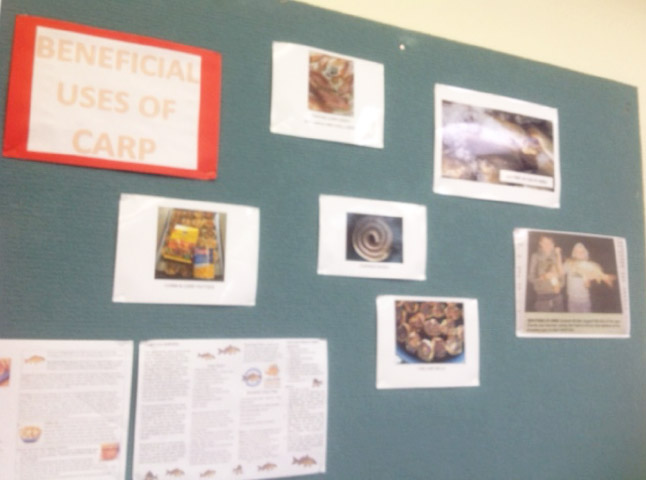
2 Carp leather is made from the skin of the fish. It is approximately six times stronger than cow hide and can be turned it into high quality articles such as handbags, purses, wallets, and key rings.
Edwards-Groves and Kemmis (2016) recently pointed out that practices inside and outside institutions limit to some degree what kinds of curriculum teachers can enact. This was very obvious in Loretta’s case. She was not limited at all in what she imagined; indeed she envisaged ambitious integrated curriculum inquiry driven by the children’s questions. However, getting out onto the school grounds to garden or beyond to the river to fish and observe remained contingent upon her being able to enlist support. As a newcomer to the school this was impossible to organise. In addition, she spent a good deal of her ‘free time’ trying to organise for experts with knowledge of the problem to visit the school. Mostly this resulted in dead-ends, even with support from the research team. Place-based environmental responsive curriculum with respect to ‘water literacies’ proved challenging to deliver.
